Law firms rarely buy AI; they buy confidence.
And confidence doesn't come from a chat window or slick UI; it comes from knowing that every answer is grounded in the right data, processed securely, and delivered with legal-grade reliability.
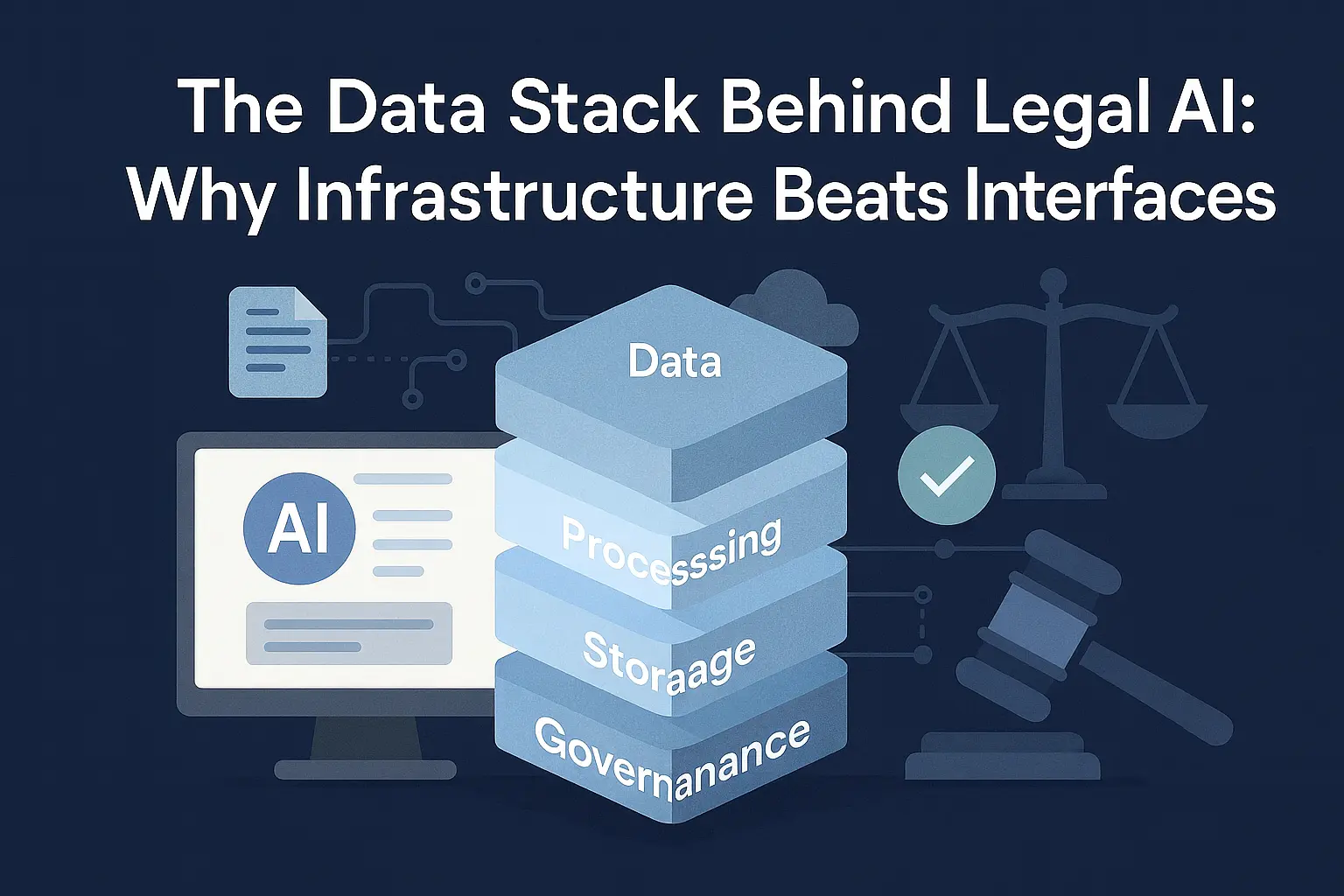
That's why in Legal AI, infrastructure beats interfaces. What sits beneath the surface the data stack, pipelines, and governance architecture determines whether an AI system becomes a trusted adviser or an unreliable distraction.
Highlights
-
Good AI is built, not wrapped. Infrastructure determines accuracy, auditability, and security.
-
Legal data stack matters. Clean, governed, and jurisdiction-aware datasets are the foundation.
-
Trust is architectural. Security, compliance, and lineage must live in the data layer not the UI.
-
Infrastructure AI = performance × integrity. Interfaces change; data foundations endure.
-
Qanooni principle: Lawyers own the intelligence their data creates.
Why Interfaces Alone Don't Deliver Legal-Grade AI
-
Generative AI can appear persuasive whilst being wrong.
-
In law, a confident hallucination is worse than silence.
-
Interfaces that look modern but rely on fragile or opaque pipelines inevitably fail to meet the profession's standards for evidence, traceability, and duty of care.
-
According to McKinsey's 2024 State of AI Report, 70% of enterprise AI initiatives underperform due to weak data foundations.
-
Legal AI is no exception; the difference between useful and risky lies in the underlying infrastructure.
-
For Legal AI to be fit for purpose, it must treat infrastructure not conversation design as the core product.
What "Infrastructure AI" Means
Infrastructure AI is the discipline of building AI systems on a governed, auditable data stack that can explain every output.
It combines:
- Data ingestion pipelines that classify, normalise, and validate legal documents.
- Embedding and retrieval layers optimised for legal language and jurisdictional nuance.
- Security and compliance controls baked into every transaction.
- Monitoring and feedback loops that continuously improve accuracy and reduce bias.
In other words, infrastructure AI is everything users don't see but always depend on.
The Anatomy of a Legal AI Data Stack
| Layer | Purpose | Legal Relevance |
|---|---|---|
| Ingestion | Capture and structure contracts, pleadings, precedents | Ensures data lineage and privilege integrity |
| Normalisation | Clean, deduplicate, and classify by matter type | Enables precise retrieval and drafting |
| Embedding | Create vector representations using legal-domain models | Improves semantic accuracy and clause recall |
| Retrieval | Connect questions to authoritative sources | Guarantees explainability and citation fidelity |
| Governance | Track provenance, permissions, and audit trails | Supports regulatory and client audits |
Why Data Infrastructure Determines AI Accuracy
-
Most AI errors stem from data, not models.
-
When inputs are inconsistent, even the smartest model misfires.
-
Legal practice amplifies this risk because documents are long, multilingual, and governed by jurisdictional context.
A strong infrastructure mitigates it through:
- Metadata discipline: tagging by clause, matter, and governing law.
- Consistent ontologies: linking templates, definitions, and outcomes.
- Retrieval governance: ensuring every answer cites a source.
- Feedback loops: letting lawyers correct and reinforce the AI's understanding.
The result: higher factual accuracy, faster reviews, and full traceability for partners and clients alike.
Security and Compliance Start at the Data Layer
Legal AI cannot rely on interface-level privacy banners; it needs structural protection.
Qanooni's infrastructure embeds access control, encryption, and auditability directly into the data flow, aligning with ISO 27001, SOC 2 Type II, and UK GDPR requirements.
This approach is also consistent with ICO guidance on responsible AI and Law Society technology guidance on maintaining client trust.
Every retrieval, embedding, or generation event follows firm-level permissions, ensuring that lawyer IP stays central, private, and compliant.
For technical readers, Microsoft provides a comprehensive Azure Architecture Centre reference on secure data pipelines that underpins much of the legal AI ecosystem.
How Qanooni Builds for Data Integrity
Qanooni's architecture follows three principles:
- Data stays sovereign. Firm materials remain under regional governance (UK GDPR, EU GDPR, GCC laws).
- Models stay stateless. AI sessions do not retain or reuse client matter data.
- Governance stays transparent. Every interaction is logged and reviewable.
For example, a mid-sized London firm migrating from an on-premise DMS to Microsoft 365 used Qanooni's infrastructure to retain full auditability under UK GDPR whilst enabling AI-native clause analysis for cross-border contracts.
By prioritising these layers, Qanooni delivers accuracy and compliance that interfaces alone can't match.
How to Build a Legal AI Infrastructure That Lasts
- Start with data governance. Map your firm's knowledge assets and classify by jurisdiction and privilege.
- Choose interoperable architecture. Ensure compatibility across document management and AI retrieval layers.
- Embed compliance early. Align storage, access, and audit protocols with ICO and SRA guidance.
- Prioritise feedback loops. Let lawyers validate AI outputs and feed them back into structured datasets.
- Scale securely. Extend only when controls and metadata maturity are proven.
Why Infrastructure Leadership Defines the Next Wave of Legal AI
-
Over the next 18 months, legal-tech differentiation will shift from features to foundations.
-
Firms will evaluate vendors not by how their chatbots look but by how their systems govern and secure data.
-
Infrastructure-first companies will lead because they can prove accuracy, compliance, and ownership values lawyers already live by.
-
Qanooni's focus on infrastructure AI positions it to help firms scale safely, turning their data into a defensible competitive advantage.
Learn More
- AI Risk and Regulation: What UK Lawyers Need to Know Before 2026
- Why Qanooni Connects to 1,000 Legal Databases, and Why It Matters
- Inside Qanooni's Microsoft Word Plugin for UK Lawyers
Frequently Asked Questions
1. Why does infrastructure matter more than interface in Legal AI?
- Accuracy and auditability depend on governed data.
- Interfaces don't affect the factual integrity of AI outputs.
- Legal risk management begins in the data layer, not the UI.
2. What is a legal AI data stack?
- It's the system that ingests, structures, secures, and retrieves a firm's knowledge.
- It ensures every output is factual, compliant, and traceable.
- It forms the foundation of trustworthy legal automation.
3. How does Qanooni's approach differ from generic AI tools?
- Qanooni builds from the data layer up.
- Compliance, traceability, and data sovereignty are embedded throughout.
- Client data never leaves the firm's governance perimeter.